

I was at Village Coffee in Kingston the other day and John, a young, warm-hearted barista and talented animator, asked me how I was. I said half-jokingly, “I feel like gum stuck on the steps of the subway.”
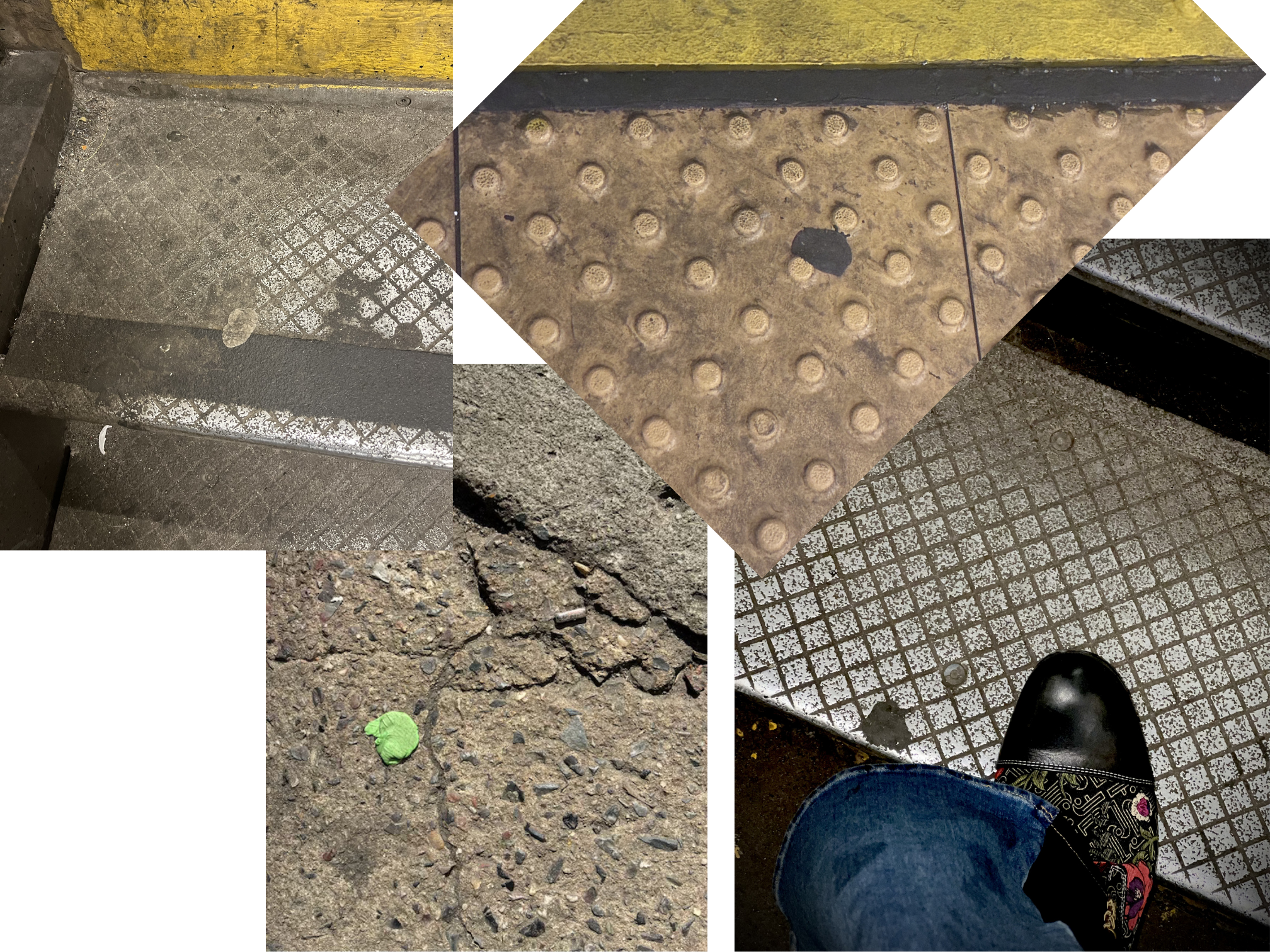
Winter, war, pedophilia president, icy sibling, the deaths of my pop, my aunt, my kitty. All these have me flattened, in a way – like old smelly stomped-on gum, ready to be rescued by careful attention, careful removal, refreshed and revitalized. Wait, the gum on the steps of the subway never gets removed. She only gets more and more smashed into the landscape, composted by the millions of people slogging towards some sort of fulfillment that comes and goes or never seems to truly arrive. Fun!
Maybe those New York City shoes are like the hooves of cows in sprawling pastures of Nebraska, where (hopefully happy) cows chew their cud, walk amongst themselves, feeding their four hungry bellies, sharing gossip, finding cover when the rain comes and sunning in relief when the sun shines bright. Their heavy hooves smashing waste into the ground - a necessary step for next year’s hay harvest.
Maybe the heaviness of winter is not meant to be peeled off the subway floor but to be smashed into the ground to simply let parts of ourselves die, to be blended into the story of humanity, composted for the next season of go-getters.
I shared this Village Coffee gum exchange with a friend. I thought it was sort of funny – with some dark truth. But she seemed concerned. Are you ok?
Feelings are uncomfortable for many people – concerning – and often looked at through the lens of “ok” or “not ok”; “right” or “wrong”; “good” or “bad”. But feelings are nondual portals into greater dimensions. And well articulated feelings can be like striking a match at midnight revealing a vast network of stories and metaphors that poke at the complexity of life. Sort of like a poem.
In 2018, poet laureate Tracy K. Smith (2017-2019) went on a tour of Rural America for “American Conversations”, inspired by her book “American Journal: Fifty Poems for our Times.” I learned of this on Krista Tippet’s On Being podcast where she said,
“And every place I went as a stranger, I was welcomed with what I really believe is love. People who were willing to sit down, read a poem, talk about what it made them feel, notice, wonder, and then do the powerful, generous leap into “This reminds me of something I’ve dealt with or something I’ve done.”
What if we brought more articulation of our feelings into conversations?
The ability to describe one’s feelings is a useful tool for opening a conversation into new territory, especially if your conversation mates are brave enough to “strike a match” and get curious. We have a conversation practice called “The Feel-It Practice…” which is an invitation to articulate how you feel. We created this because feelings are a sort of intangible embodied sensation or you can refer to the non-violent communication feelings list. But we find feelings to also be more than that. When you bring a metaphor to your feelings they become spatial, visual, and representational. And in a world that rewards a head-orientation to life, we are generally not that good at articulating it. When we do this practice, we become more present.
The Feel-It practice essentially helps us to grease our mental, emotional, spiritual wheels so we can open to the complex, multi-dimension wisdom of feelings of every moment. It sort of goes like this:
Person A: How do you feel?
Person B: (Name your body sensations) I feel a tightness in my jaw and an energy in my temples. (Name a metaphor for the feeling - first thing that comes to mind) I feel like a big metal ball about to roll down a too-steep mountain.
Then you switch, going back-and-forth 5 times.
If you want to try it out, watch the video and download it here:
This practice helps us peek into the invisible, becoming everyday poets. Bayo Akomolafe, a Nigerian born teacher and author recently spoke at The Good Work Institute. He talked about seeing into the cracks of life, those dark elusive surprising places as a way to begin to spin away from the tangly web of the ordered and oppressive colonization that hangs on our every word looking for what’s right or wrong. Could our feelings free us?
When someone asks how I am, I have a muscle that helps me to find that metaphor.
“I feel like gum stuck on the steps of the subway.”
How about you? How do you feel?